
If you’ve ever wondered how quickly sperm “come back” after ejaculation, you’re not alone. It’s one of those questions that pops up in fertility forums, late-night Google searches, and sometimes even in casual conversation (though, maybe only with close friends). The curiosity makes sense. Sperm are tiny, invisible to the naked eye, and yet they play a huge role in conception. And the idea of them “regenerating” in just half a day or how much sperm is produced in 24 hours? That sounds almost too good to be true.
But before we jump straight to the 12-hour question, it’s worth understanding what sperm production actually looks like inside the male body. Because the reality is, sperm have a surprisingly long and complex life cycle. It’s not as simple as refilling a glass of water.
Also read: Azoospermia Explained
How Sperm Are Made
Sperm production or spermatogenesis happens in the testicles. Specifically, in the seminiferous tubules, which are kind of like microscopic production lines. The process starts with germ cells, which slowly transform into mature sperm over a series of steps.
Now, here’s where patience comes in. From start to finish, making a fully functional sperm cell takes about 64 to 72 days. Yes, days. That’s over two months from the first cell division to a sperm that’s ready for its mission.
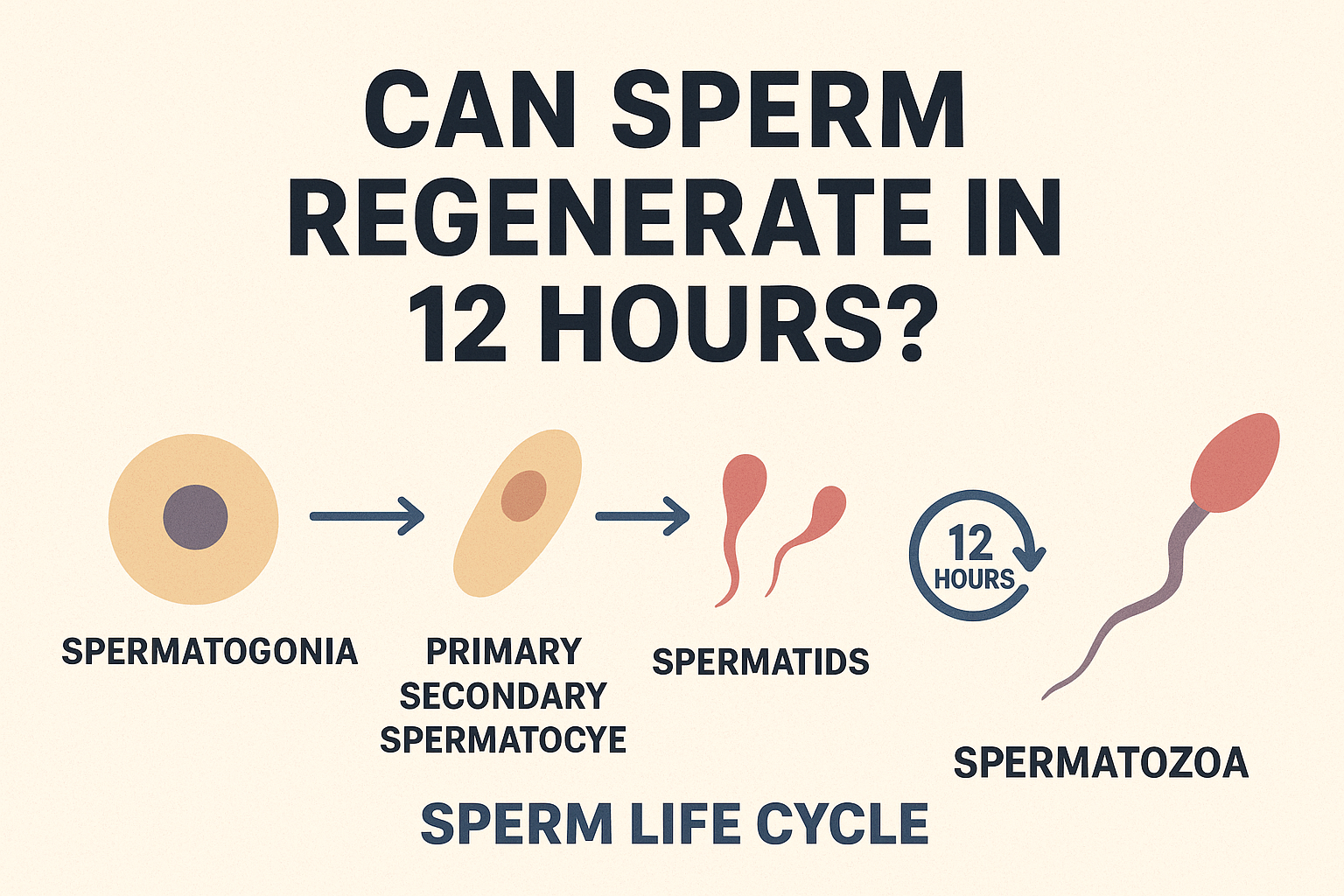
During that time, cells go through multiple stages:
- Spermatogonia – the starting stem cells.
- Primary and secondary spermatocytes – cells dividing and reshaping.
- Spermatids – immature sperm that don’t yet have the tail strength for swimming.
- Spermatozoa – the finished product.
Once they’re ready, sperm leave the testicles and enter the epididymis. A long, coiled tube where they gain motility and the ability to fertilize an egg. That storage-and-training period adds another two to three weeks. So, by the time sperm are “ready for action,” they’re actually several months old.
So… Does That Mean Once They’re Gone, They’re Gone?
Not quite. While it takes months to make a sperm from scratch, the body is producing them constantly. Think of it like an assembly line that never stops. There’s always sperm at different stages of development.
After ejaculation, you’re not suddenly “empty.” Millions of sperm remain in storage, and more are being completed every single day. The average male produces about 1,500 sperm per second. That’s over 100 million a day. So, yes, the numbers replenish quickly, but “replenish” here means topping up the supply, not creating brand-new sperm overnight.
This is where the 12-hour myth gets tricky. You might have enough sperm in the reservoir to ejaculate again within hours, but those sperm were already made beforehand. They didn’t just regenerate in that short time. They were sitting in storage, waiting for deployment.
What Happens After Ejaculation?
When ejaculation happens, sperm are mixed with fluids from the prostate, seminal vesicles, and other glands to form semen. A single ejaculation can contain anywhere from 40 million to over 300 million sperm (yes, the range is huge).
Afterward, the body doesn’t just shrug and start from zero. The remaining sperm in the epididymis are still there, and the production line in the testicles is still running. You could technically ejaculate multiple times a day, but there are trade-offs:
- Lower sperm count per ejaculation – More frequent release can mean fewer sperm each time, because you’re tapping into the reserves faster than they’re replenished.
- Lower semen volume – The fluids that make up semen also need time to rebuild.
- Potential quality changes – Motility (swimming ability) and morphology (shape) can dip if you’re releasing very often.
So, while you can have sperm in your ejaculate within 12 hours (or less) of the last time, it’s not because your body magically produced them from scratch that fast. It’s because you already had them ready.
The “12-Hour Regeneration” Claim — Where Does It Come From?
I’ve seen this idea floating around in different places. Sometimes in fertility Q&As, sometimes in gym locker talk. My guess? It probably comes from people noticing that men can ejaculate again after a short break, so they assume sperm must regenerate at lightning speed.
There’s also the fact that sperm count can partially recover within 12–24 hours simply because the body pulls from its existing reserves. But full regeneration of the entire supply? That’s a multi-day, even multi-week, process.
Think of it like eating from a pantry. If you snack on something in the morning and then again at night, you’re not restocking the shelves from scratch in those 12 hours. You’re just grabbing from what’s already there.
Sperm Storage and “Turnover”
The body stores mature sperm in the epididymis for up to a few weeks. If they’re not used, they eventually break down and get reabsorbed. New sperm are constantly entering storage as older ones leave.
Ejaculation speeds up this turnover, which is partly why some fertility specialists actually recommend regular ejaculation (every 2–3 days) when trying to conceive. It keeps the sperm supply fresh and reduces the number of older, less mobile sperm in the mix.
But too-frequent ejaculation (say, multiple times a day for several days in a row) can temporarily lower your overall sperm count and semen volume. That might not matter for everyday life, but if you’re tracking fertility windows, it can be a consideration.
Factors That Affect Sperm Recovery Time
While the biological cycle is broadly similar for everyone, a few factors can make sperm count recover faster or slower after ejaculation:
- Age – Younger men tend to produce sperm at higher rates, though production never really stops in healthy males.
- Overall health – Illness, high fever, hormonal imbalances, or chronic conditions can slow production.
- Lifestyle – Poor diet, heavy alcohol use, smoking, and certain drugs can all reduce sperm production or quality.
- Heat exposure – Frequent hot tub or sauna use can temporarily lower sperm count.
- Frequency of ejaculation – As mentioned, frequent release can lower the sperm per ejaculation, though production continues in the background.
Can You Boost Sperm Production?
You can’t make the process dramatically faster. But you can support healthy production and improve the quality of what you have. Common science-backed tips include:
- Eat nutrient-rich foods – Especially those high in zinc, vitamin C, vitamin D, and antioxidants.
- Exercise moderately – Good circulation and hormone balance support sperm health.
- Maintain a healthy weight – Obesity can affect hormone levels and sperm quality.
- Avoid excessive heat to the groin – That includes tight underwear, laptops on laps, and long hot baths.
- Limit toxins – Smoking, excessive drinking, and certain chemicals can impair sperm.
These won’t turn you into a “super-producer” overnight, but they can improve your baseline fertility over time.
Where the 12-Hour Idea Falls Short
The main problem with the “regenerate in 12 hours” concept is that it mixes two different ideas: having sperm available and creating new sperm from scratch.
Yes, sperm are available within hours, because they were already stored in the epididymis. But producing new sperm is slow and steady. You can’t rush the biology much faster than it already goes.
So, if someone says, “Don’t worry, you’ll have fresh sperm in 12 hours,” they’re partly right but also missing the bigger picture. The sperm you have in that short time aren’t freshly manufactured; they’re from stock you already had.
A Little Perspective
Sperm production is one of those quiet, behind-the-scenes processes we barely think about, yet it’s happening constantly. Even when you’re asleep, your testicles are working through their months-long assembly line, producing millions of cells that will never be seen by the naked eye.
The system is efficient, but not instant. Maybe that’s a good thing. It keeps the quality control in check. After all, rushing the process could mean more mistakes in the genetic blueprint. And in reproduction, details matter.
Also read: CoQ10 for Fertility: 7 Ways to Boost Your Reproductive Health
Final Answer: Can Sperm Regenerate in 12 Hours?
If we’re talking about new sperm cells? No, that’s a 2–3 month process from start to finish.
If we’re talking about refilling enough sperm to ejaculate again? Yes, you can have sperm available in that time, but they were already made, just waiting in storage.
So, the better question might be: “How soon can I have a viable sperm count again after ejaculation?” And the answer depends on how much was released, how healthy your production line is, and how often you’re ejaculating overall.
Key Takeaways:
- Sperm production takes 64–72 days, but the body is making them continuously.
- After ejaculation, stored sperm are still available you don’t start from zero.
- Sperm counts can recover partially within 12–24 hours, but these aren’t newly made sperm.
- Health, age, and lifestyle all influence sperm production speed and quality.